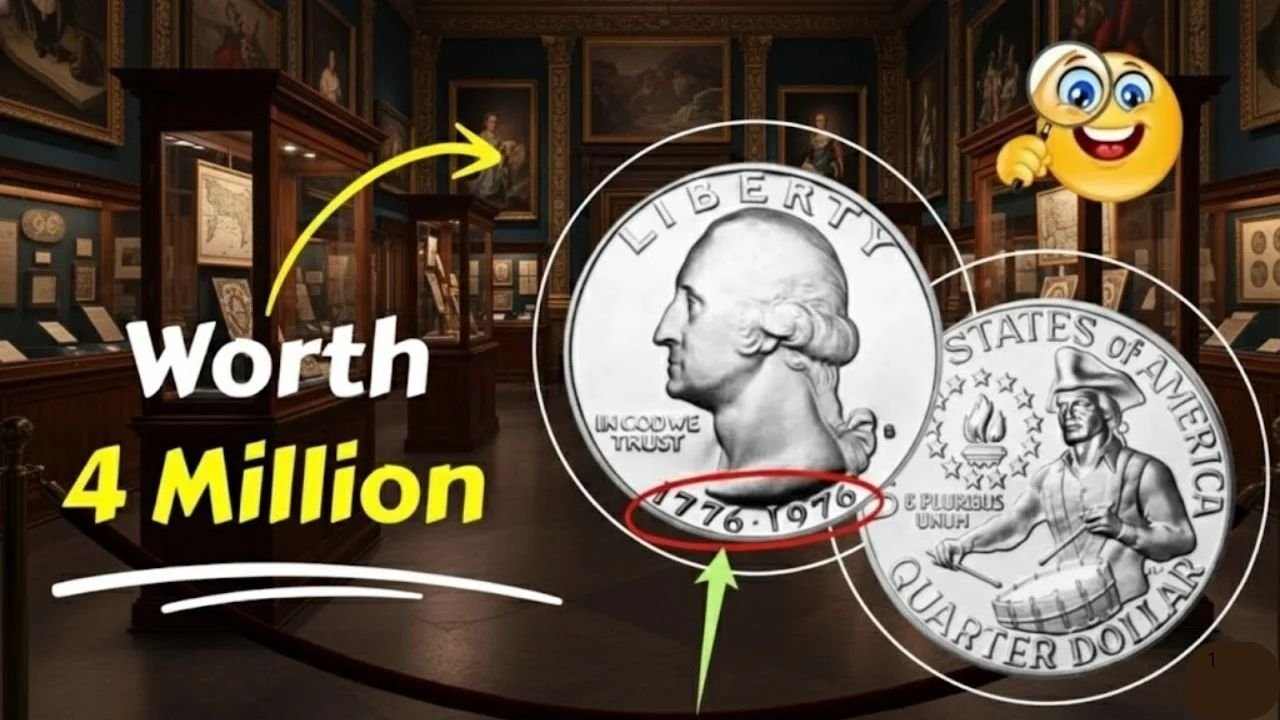
The 1976 Bicentennial Quarter is among the most iconic commemorative coins in American history, minted to celebrate the nation’s 200th anniversary. While hundreds of millions circulated widely, a tiny fraction has emerged as highly prized collector’s items, with certain perfect-grade proofs reportedly fetching values in the millions. Understanding what makes one of these quarters exceptional requires knowledge of its origin, condition, and unique characteristics, as well as an appreciation for its role in national heritage.
A Coin Forged in Celebration
The bicentennial of the United States marked a moment of national reflection, pride, and commemoration. For the quarter, the familiar obverse portrait of George Washington remained, while the reverse featured a new design by Jack L. Ahr. This design showcases a colonial drummer boy with a victory torch, encircled by thirteen stars representing the original states. Quarters from both 1975 and 1976 bear the dual date “1776-1976,” permanently linking them to the anniversary. Released into everyday circulation, these coins were intended both for spending and saving, making the rare high-grade examples all the more remarkable when discovered decades later.
Complete Information Table: The 1976 Bicentennial Quarter
| Aspect | Details |
|---|---|
| Coin Denomination | Quarter Dollar (25 Cents) |
| Commemorative Theme | 200th Anniversary of American Independence |
| Years Dated | 1776-1976 (Struck in 1975 & 1976) |
| Designer | Jack L. Ahr (Reverse – Drummer Boy) |
| Standard Circulation Issue | Copper-Nickel Clad, Philadelphia & Denver Mints |
| Special Collector Issue | Proof & Silver Proof (40% Silver), San Francisco Mint (“S” mint mark) |
| Total Circulation Mintage | ~1.7 billion (Philadelphia & Denver) |
| Primary Value Drivers | Mint mark, condition/grade, composition (Silver vs. copper-nickel) |
| Market Perspective | Most circulated coins worth 25 cents; certified high-grade proofs can exceed $1M |
Understanding the Pathways to Rarity
The majority of Bicentennial Quarters are worth face value, but identifying one with significant numismatic value involves three key factors: origin, condition, and unique characteristics.
Origin: Mint marks are critical. Circulation strikes came from Philadelphia (no mint mark) and Denver (“D”), while San Francisco “S” proof coins were made for collectors. Proof coins feature mirror-like surfaces, frosted designs, and higher levels of detail. These are where the most valuable examples are found.
Condition/Grade: The coin’s state of preservation directly affects value. Any handling, even minor contact marks, can reduce worth. Mint state or proof coins retaining full luster and detail are exceptionally rare. Professional grading services evaluate coins on a 70-point scale, with MS or PR-67+ representing extraordinary preservation.
Unique Minting Characteristics: Occasionally, production errors or planchet anomalies create a unique specimen. Misaligned dies, doubled strikes, or slight composition variations are extremely rare but can dramatically increase collector interest.
A Responsible Approach to Identification and Value
If you encounter a Bicentennial Quarter that appears exceptional, particularly an “S” mint proof, handle it carefully by its edges and avoid cleaning. Cleaning removes original luster and can permanently damage the coin, drastically reducing value. For professional assessment, submit the coin to respected grading services such as the Numismatic Guaranty Company (NGC) or the Professional Coin Grading Service (PCGS). These organizations authenticate, grade, and encapsulate coins, providing security and market credibility.
Realistic Market Perspective
While multi-million-dollar sales for perfect-grade proof Bicentennial Quarters exist, these represent the extreme peak of the market. Most circulated or ungraded coins, even with an “S” mint mark, are worth substantially less. Collector guides, auction archives, and verified sales provide the most reliable benchmarks, rather than sensational headlines.
A Legacy Beyond Metal
The true value of the Bicentennial Quarter extends beyond its monetary potential. Each coin is a tangible artifact from a defining national celebration. Whether it is a worn coin discovered in a register or a pristine proof set preserved for decades, it tells a story of its era. Examining these coins, appreciating their design, and considering their historical journey fosters a meaningful connection to the past, transforming a simple act of checking change into an encounter with history.
Frequently Asked Questions (FAQ)
Q1: Is every 1976 quarter valuable?
A1: No. Hundreds of millions were produced for circulation, most worth only 25 cents. Significant value exists only for flawless, professionally graded coins, particularly proofs with an “S” mint mark.
Q2: What should I look for first?
A2: Check the mint mark. An “S” near Washington’s hairline indicates a San Francisco proof. Next, assess the surface for full, sharp detail and original luster—no wear or scratches.
Q3: What should I do if I think my coin is valuable?
A3: Do not clean it. Handle by edges, place it in a protective holder, research traits using reputable numismatic sources, and consider professional grading or authentication.
Q4: Why is cleaning harmful?
A4: Cleaning scrubs microscopic scratches, removes toning, and destroys both historical integrity and collector value, often reducing a valuable coin to a damaged state.
Q5: Are multi-million-dollar valuations real?
A5: Yes, but they reflect rare perfect-grade PR-70 silver proof coins, authenticated by top grading services. Typical “S” mint proofs are valuable but generally worth far less.
The 1976 Bicentennial Quarter is more than currency—it is a piece of history, a celebration in your pocket, and occasionally, a gateway to extraordinary collector value.